

Your top news on science and technology
Provided by AGP
In-situ atomic imaging points to a mechanism-driven growth future for 2D materials
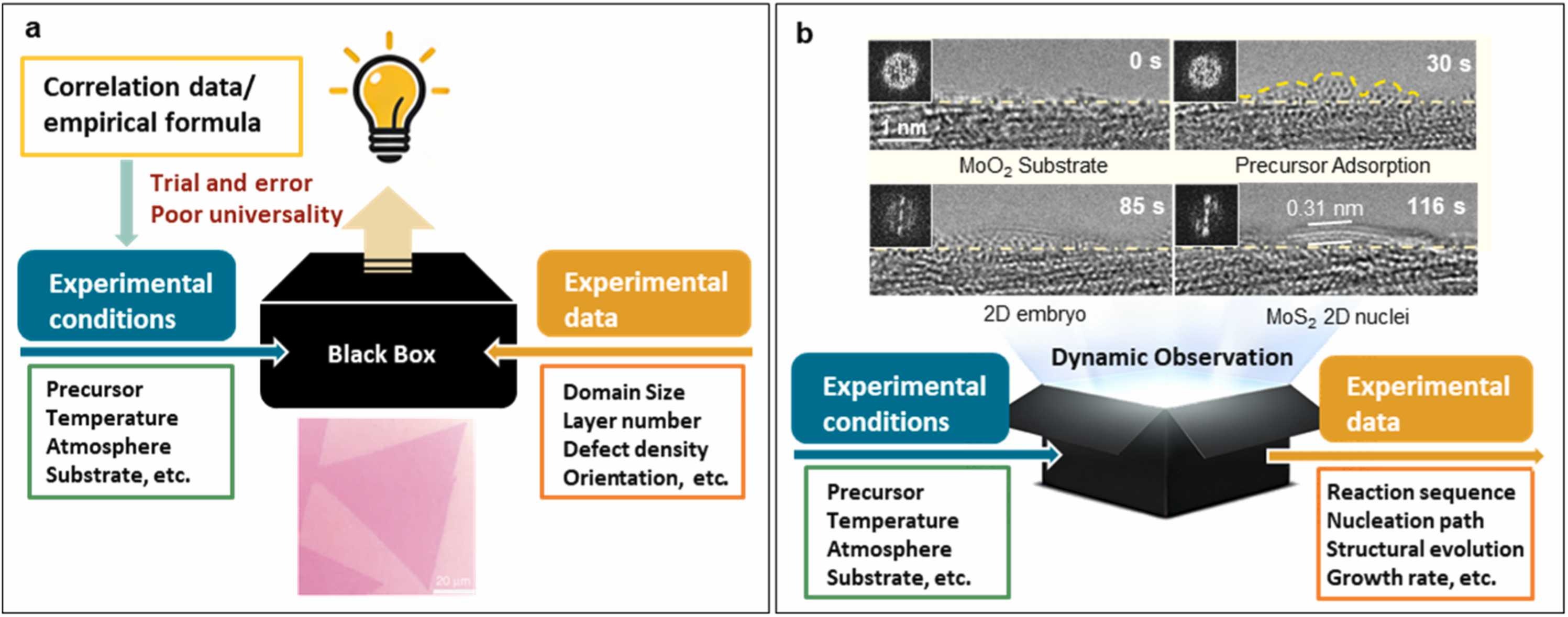
Conceptual illustration of the paradigm shift from traditional result-oriented approaches that infer growth mechanisms from final products (a) to in situ characterization that reveals transient intermediates and dynamic trajectories that govern materials
GA, UNITED STATES, May 14, 2026 /EINPresswire.com/ -- A new Perspective published in Originality draws broader scientific meaning from a recent Science breakthrough in two-dimensional (2D) materials research, arguing that in-situ atomic-scale characterization may become a key enabling tool for atomic manufacturing. The underlying advance came from direct atomic-scale observations of molybdenum disulfide (MoS2) growth during chemical vapor deposition, where researchers captured a multistep pathway from amorphous clusters to 2D embryos and finally to crystalline nuclei, as well as aggregation and oriented attachment behaviors in the early growth stage that help reduce grain boundaries and facilitate single-crystal formation. By placing these discoveries in a wider framework, the Originality article argues that real-time atomic observation can help turn crystal growth from aa largely empirical process into one guided by mechanism and design.
Controlling how two-dimensional (2D) materials nucleate and grow is a long-standing challenge in nanoscience. These atomically thin materials are widely seen as promising building blocks for future electronics, energy systems, catalysis, and advanced manufacturing, but their growth is often optimized through trial and error because the earliest stages of formation are extremely difficult to observe. Traditional ex-situ characterization usually captures only the final state, leaving the dynamic pathways of nucleation and early crystal development hidden inside a mechanistic “black box.” Because of these challenges, deeper study is needed to connect atomic-scale structural evolution with the scalable fabrication of high-quality 2D materials.
In the new Perspective, published in Originality on 25 April 2026, Academician Hui-Ming Cheng builds on a recent Science study co-authored by Prof. Rongming Wang and colleagues, which revealed the atomic-scale nucleation and growth behavior of MoS₂ under chemical vapor deposition conditions, including not only a multistep nucleation pathway from amorphous clusters to 2D embryos to crystalline nuclei, but also aggregation and oriented attachment behaviors during the early growth stage that help reduce grain boundaries and facilitate single-crystal formation. The Originality article argues that this work does more than solve a materials-science puzzle: it provides a mechanistic foundation that could inform the controlled growth and eventual atomic manufacturing of 2D crystals.
The Science study showed that MoS₂ nucleation does not begin as a simple direct transition to an ordered crystal. Instead, the team observed a nonclassical, multistep route: precursor species first formed disordered amorphous clusters, which then evolved into layered 2D embryos with limited in-plane order, and only later rearranged into stable crystalline nuclei after reaching a critical size. The researchers also captured aggregation and oriented attachment in the early growth stage, processes that may help reduce grain boundaries and support the formation of high-quality 2D crystals. In the Originality Perspective, Cheng argues that this ability to watch structural and chemical evolution in real time is precisely what can move the field from experience-driven growth toward mechanism-driven manufacturing.
“This work suggests that in-situ atomic-scale characterization is becoming far more than an observational tool,” the article indicates. “By revealing how 2D crystals actually emerge, reorganize, and stabilize, it provides a framework for designing growth pathways instead of merely testing them after the fact.” In this view, the value of the in-situ MoS2 growth study lies not only in its insight into one material system, but also in its demonstration that atomic-resolution, real-time characterization can supply the missing mechanistic foundation needed for broader innovation in 2D crystal growth and atomic-scale manufacturing.
For Originality, the publication of this Perspective reflects the journal’s emphasis on originality, interdisciplinary frontiers, and globally relevant scientific ideas. By bringing a Science-level discovery into a broader discussion of atomic manufacturing, the journal positions itself not only as a venue for reporting important advances, but also as a platform for interpreting why those advances matter for the future of science and technology. As in-situ tools continue to improve in spatial resolution, environmental fidelity, and data interpretation, the Perspective suggests that they may help unlock more predictive and controllable routes to building tailored 2D materials for next-generation applications.
References
DOI
10.1016/j.orig.2026.04.001
Original Source URL
https://doi.org/10.1016/j.orig.2026.04.001
Lucy Wang
BioDesign Research
email us here
Legal Disclaimer:
EIN Presswire provides this news content "as is" without warranty of any kind. We do not accept any responsibility or liability for the accuracy, content, images, videos, licenses, completeness, legality, or reliability of the information contained in this article. If you have any complaints or copyright issues related to this article, kindly contact the author above.
