

Static Voltage Stabilizer for Industrial Power Protection: Service Support by Shenzhen SST Power
What a Static Voltage Stabilizer Protects in Industrial Power Systems
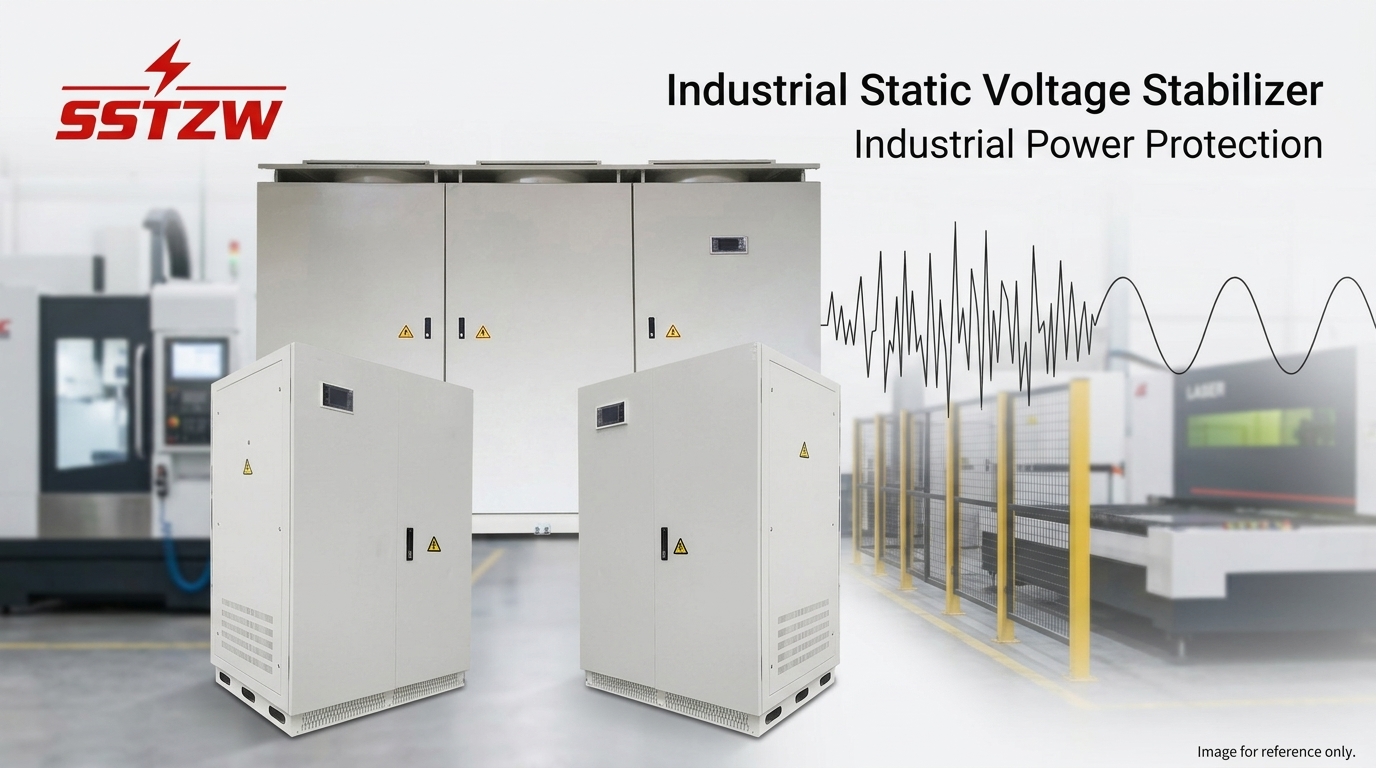
A static stabilizer does not apply a one-time correction to the incoming supply. Instead it samples the waveform, calculates the deviation, and uses SCR switching to compensate continuously, giving sensitive equipment a steadier supply. The ZW-D and ZW-S series are built from an isolation transformer, SCR modules, a CPU control core, fast regulation technology, and safety protection devices, and non-contact control reduces the need for mechanical parts to move through every adjustment. In laser cutting, CNC machining, and broadcast facilities, even small voltage deviations can disturb high-value equipment. So the stabilizer's role is less about vanity precision and more about acting as a power-quality buffer and a guard against abnormal states.
ZW-D and ZW-S Configurations for Industrial Loads
The two product lines cover most industrial scenarios. ZW-D serves single-phase loads, with rated capacity from 3 to 150 kVA, a standard input range of plus or minus 20 percent that can be adjusted by project toward a wider window, and output accuracy adjustable within plus or minus 1 to 5 percent. ZW-S serves three-phase industrial loads, with rated capacity from 10 to 4000 kVA and the same room to configure input range, output accuracy, and voltage to the project. Selection follows a clear order: confirm the load's phase and capacity, measure the site's input fluctuation range, set the target output accuracy, then check the installation environment and protection needs. Final parameters should always come from the quotation and model datasheet.
Fast Non-Contact Regulation and Layered Protection
The advantage of non-contact regulation is speed with less mechanical wear. SCR switching and CPU control complete compensation from the sampled result, without carbon brushes moving back and forth. A high-precision CNC project on record reached up to 1 percent accuracy with response within 40 ms, across purchased units of varied capacity, and those figures describe that project rather than a blanket promise for every model. Broadcast and television work shows the layered protection logic more fully, with delay, overvoltage, undervoltage, reverse phase, phase loss, and overcurrent protection and alarm, alongside fast regulation and automatic three-phase balancing. The division is deliberate. Fast response shortens how long a voltage anomaly lasts, while the protection functions form a second line when a disturbance runs beyond the regulation range.
Industrial Application Proof for Laser, CNC, and Broadcast Equipment
Public cases show how sizing works in practice. A Han's Laser project paired a 3000 W laser machine with a 30 kVA non-contact stabilizer, a reminder that capacity has to match the protected equipment's real power, its start-up conditions, and the site's voltage swing. A high-precision CNC project spanned a wide capacity range, showing how one industrial setting changes its needs as equipment is added, so standard product ranges and project-level selection have to advance together. The broadcast room case centered on overvoltage, undervoltage, surge spikes, and three-phase supply problems. What the cases prove is not a universal parameter but a method: identify the load, match the capacity, configure the protection, and back it with service.
Installation Conditions That Shape Stabilizer Performance
Electrical selection is only half the picture. The standard ZW-D and ZW-S configurations assume indoor use, and outdoor duty needs a separate custom build rather than forcing an indoor unit into an exposed or high-protection setting. The working envelope covers ambient temperature from minus 15 to plus 40 degrees Celsius, relative humidity no higher than 90 percent, and altitude no higher than 1000 m, with the install location kept free of heavy vibration, shock, and explosive or corrosive media that would harm insulation. Temperature, humidity, altitude, ventilation, vibration, and corrosion all influence enclosure, cooling, and protection choices, so they belong in the technical inputs at the solution-confirmation stage, not as an afterthought.
Service Support from Power Assessment to Lifecycle Tracking
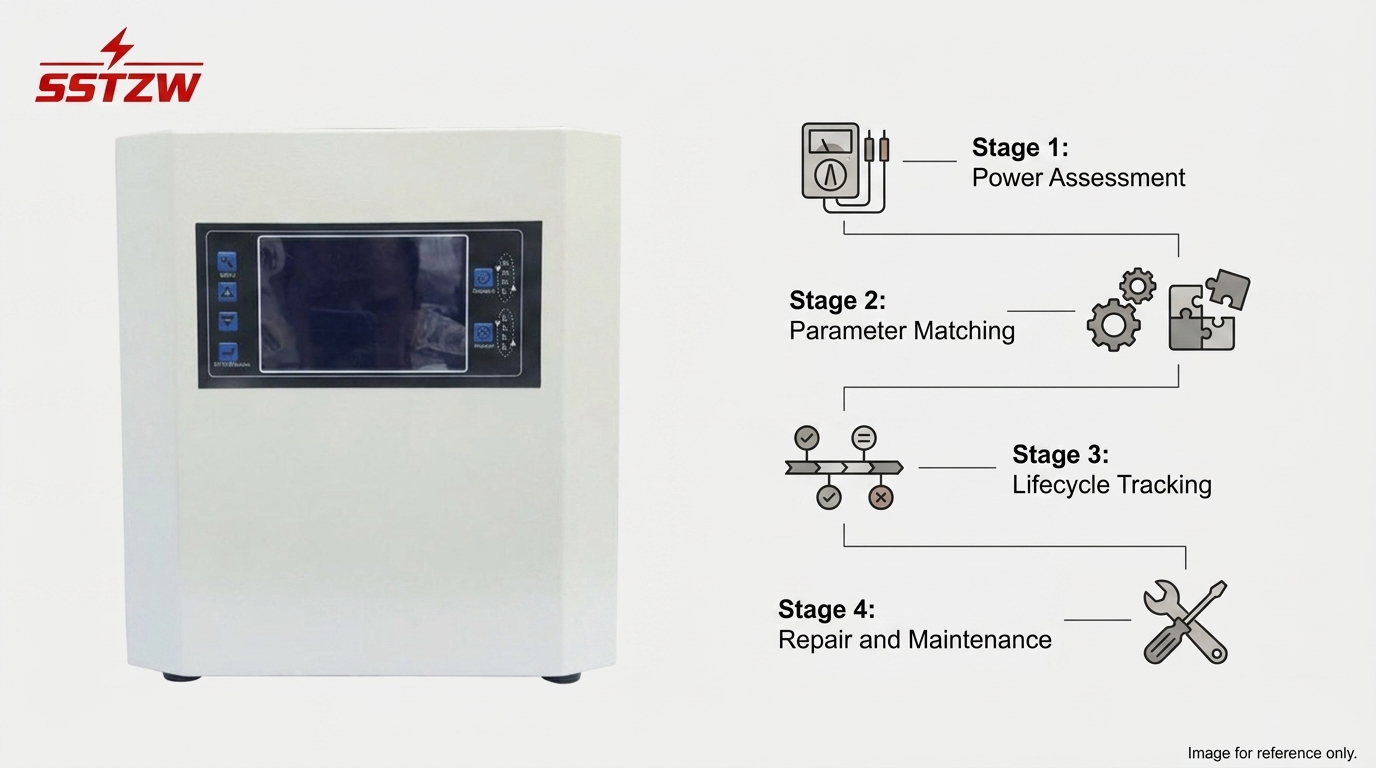
This is where product and service meet. Shenzhen SST Power begins with a pre-sales assessment of the power environment, building a configuration recommendation from load, phase, capacity, voltage fluctuation, and installation conditions, rather than naming a model before the site data exists. After delivery, long-term contact, quality tracking, and rapid repair and maintenance support carry the stabilizer's value from selection into daily operation, while OEM and ODM capability gives special voltages and project requirements a place to be configured. The full path runs from requirement capture to parameter matching, solution and model confirmation, production and delivery, operational tracking, and finally fault repair and maintenance response. The business links R&D, manufacturing, sales, and technical support across more than 40 countries and regions.
Industrial static voltage protection is not the work of a single component. The ZW-D and ZW-S ranges carry the voltage regulation and protection, while project consultation turns phase, capacity, fluctuation range, accuracy, and environment into a specific, buildable configuration. That combination, guided by a service first and customer first commitment, is what keeps sensitive industrial loads running through the disturbances a standard supply cannot smooth on its own. Buyers ready to move can share a load list, measured site input voltage, target output accuracy, phase, capacity, and installation environment with Shenzhen SST Power at https://www.sstpowerltd.com/ to begin static stabilizer solution confirmation.
Shenzhen SST Power Co.,Ltd.
Shenzhen SST POWER
+ +8618718357506
email us here
Legal Disclaimer:
EIN Presswire provides this news content "as is" without warranty of any kind. We do not accept any responsibility or liability for the accuracy, content, images, videos, licenses, completeness, legality, or reliability of the information contained in this article. If you have any complaints or copyright issues related to this article, kindly contact the author above.
